

When Should a Self-Managed HOA Hire a Management Company?
Most self-managed HOAs that hire a management firm wait too long. The decision usually gets made in the middle of a crisis — a special assessment vote that exposed the reserves gap, a lawsuit threat that exposed the compliance gap, a volunteer treasurer who quit and took the institutional knowledge with them. By the time the board calls, the cost of the transition is being measured against the cost of the crisis rather than against the long-term operational value.
Boards that decide proactively get a different deal. They run a structured evaluation while operations are stable, compare firms on the merits, and transition during a calm period rather than a stressed one. The decision still costs real money in management fees. The decision also avoids the much larger costs that compound while the board waits.
This guide is the framework for making the decision proactively. Five signals that indicate it's time, the honest counter-cases for staying self-managed, and the question the board should actually be asking — which isn't whether to hire management, but whether the operational rhythm of the community has run past what volunteer governance can sustain.
The wrong question and the right question
The wrong question is "should we hire a management company?" That framing positions hiring as an admission of failure — the board couldn't handle it, so they need outside help. Boards resist the framing because it triggers volunteer pride, and they make worse decisions as a result.
The right question is "does our operational rhythm match our community's complexity?" That framing is structural rather than judgmental. Some communities are simple enough that volunteer governance is the right operational rhythm forever. Some communities are complex enough that volunteer governance can never sustain them. Most communities sit somewhere in the middle and shift over time as they age, grow, or change.
When the operational rhythm matches the complexity, self-management works. When it doesn't, things break — usually slowly at first, then faster, then in expensive bursts that the board sees as crises but were actually predictable.
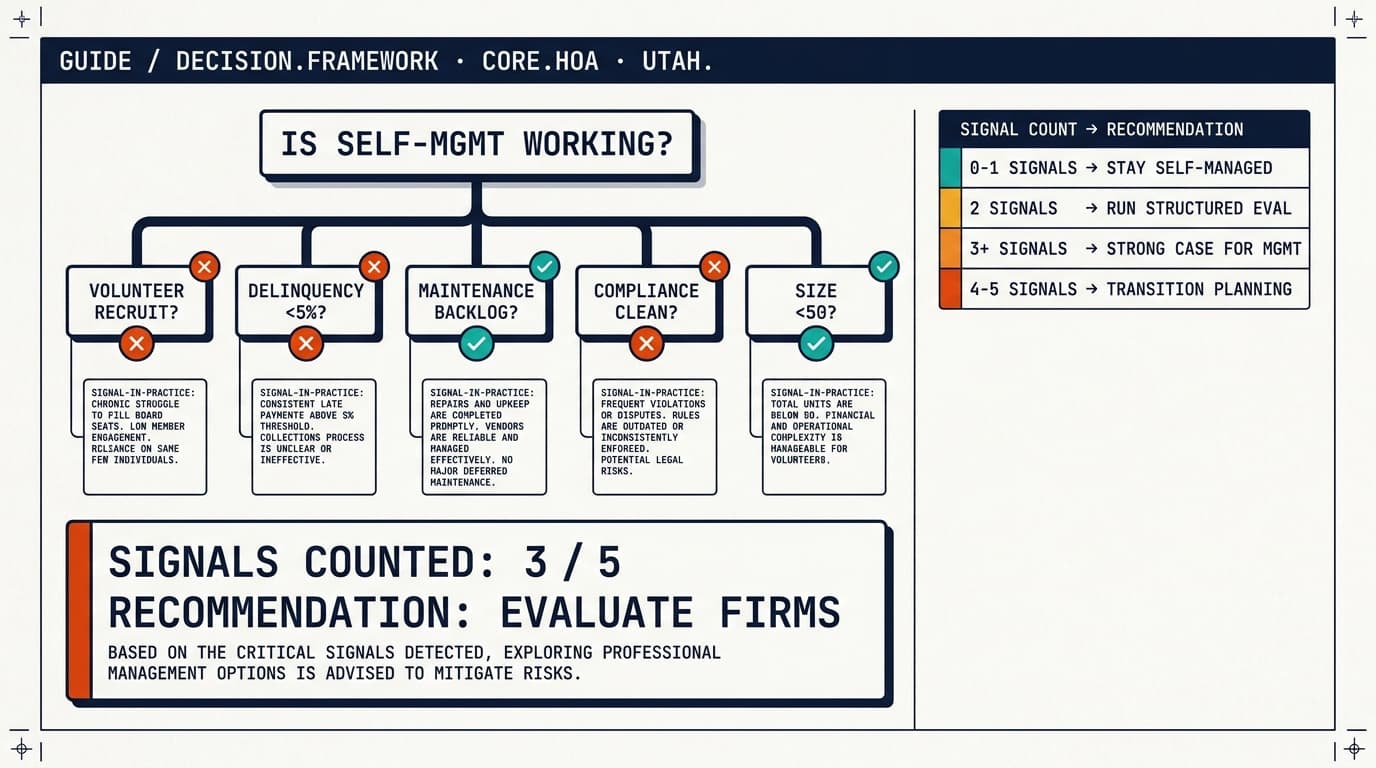
The five signals below are the structural indicators that the rhythm has stopped matching.
Signal 1 — Volunteer recruiting has become structurally difficult
The most reliable single signal. A community where every board recruitment cycle produces three willing candidates is operating within volunteer governance's capacity. A community where the board chair has been begging for replacements for twelve months and getting "thanks but no thanks" from every neighbor approached has run past it.
This isn't about specific personalities or community engagement. It's about the volunteer hours required to run the community versus the volunteer hours the community can sustain. When the math doesn't balance, no amount of recruiting effort fixes it. The community either professionalizes or runs the existing volunteers into burnout.
Counter-case for staying self-managed: If recruiting difficulty is recent and might be temporary (post-pandemic disruption, a difficult board cycle that scared off candidates), give it another year. If recruiting difficulty has persisted for three or more board cycles, the structural conclusion is unavoidable.
Signal 2 — Chronic delinquency above 5%
Delinquency above 5% is structurally meaningful for two reasons. First, it indicates collection processes aren't working — either the cadence is inconsistent or the volunteers responsible aren't equipped to escalate to formal collection action. Second, the cumulative financial impact at that level starts affecting reserves and operations in ways the board can't easily backfill.
A community at 5% delinquency on $300/month dues across 80 doors is losing $14,400 per year. Over five years that's $72,000 — usually more than five years of management fees would have cost.
Counter-case for staying self-managed: If delinquency is concentrated in 1-2 specific units that the board is actively pursuing through legal action, that's a temporary spike rather than a structural pattern. If delinquency is distributed across many units and persists across years, the collection rhythm is broken and self-management isn't fixing it.
Signal 3 — Deferred maintenance is compounding
The maintenance pattern in self-managed communities follows a predictable arc. Year one: things are in good shape from initial development or recent capital investment. Year five: minor deferrals accumulate but are still recoverable. Year ten: deferrals are visible and starting to drive vendor cost increases at replacement. Year fifteen: the community faces a major capital project that the reserves don't cover.
The signal isn't the existence of deferred maintenance — every community has some. The signal is whether the backlog is growing, stable, or shrinking. A growing backlog means the community is losing ground; a stable backlog means the board is keeping up; a shrinking backlog means the board is catching up.
Most self-managed boards can keep up with maintenance for the first ten years. Many cannot keep up after that, especially as major components age toward replacement simultaneously.
Counter-case for staying self-managed: If the board has implemented a scheduled inspection rhythm and a multi-year capital plan, self-management can absorb significant maintenance volume. The variable is process, not management structure. Boards that haven't built the process need either to build it or to hire a firm that comes with one.
Signal 4 — Compliance failures have produced legal or financial exposure
This is the highest-severity signal because the cost is concrete and visible. A missed insurance renewal that produced a denied claim. A statutory filing deadline that produced a state fine. A discriminatory enforcement pattern that produced a lawsuit. A reserve study deferral that produced a homeowner challenge.
Each individual incident might be a one-time mistake. The pattern of incidents is the structural signal. Communities that have experienced two or more compliance failures in a 24-month window have demonstrated that the compliance rhythm isn't holding.
Counter-case for staying self-managed: A single compliance failure in an otherwise clean operating record can usually be addressed with documented procedural improvements — a written compliance calendar, a backup person assigned to each obligation, a board policy of formal review at every meeting. Two or more failures suggest the procedural improvements aren't working.
Signal 5 — Community size or complexity has grown past 50 doors
Size isn't destiny but it's strongly correlated. Communities under 25 doors can typically self-manage indefinitely. Communities between 25-50 doors are in the gray zone where it depends on board capacity and infrastructure age. Communities over 50 doors almost always benefit from professional management.
The reason is operational volume. A 25-door community might have 50-100 homeowner inquiries per year, 5-10 vendor relationships, one or two major maintenance items. A 100-door community has 200-400 inquiries, 15-25 vendors, multiple ongoing maintenance projects, and a board cycle that can't pause for individual attention. The work scales faster than volunteer time scales.
Counter-case for staying self-managed: A 50+ door community with a strong board, professional volunteers (e.g., a CFO who treasures the role, a contractor who handles maintenance), and stable infrastructure can self-manage successfully. The combination of factors that makes this work is unusual and tends not to persist across board turnover.
How to count the signals
Run through the five signals and count which ones the community is currently experiencing.
- Zero or one signal: Stay self-managed. Address the specific signal directly with procedural improvements.
- Two signals: Run a structured evaluation. Get proposals from two or three management firms. Compare cost of management against cost of the signals continuing.
- Three or more signals: The structural case for hiring management is strong. The transition can still be timed proactively rather than reactively if the board acts now.
- Four or five signals: The community has run past self-management's capacity. The question isn't whether to hire management; it's how quickly to transition.
The framework is calibrated against Core HOA's experience reviewing self-managed communities at proposal stage. Boards typically come to us with three or four signals visible. Boards with one or two often stay self-managed after the conversation, and we tell them so directly.
For deeper diagnostic on what specific operational problems are driving the signals, see Top 10 Self-Managed HOA Problems.
What about a hybrid approach?
A frequently overlooked option: hire a management firm for specific functions while staying self-managed overall. The most common patterns:
-
Financial-only management. The firm handles accounting, collections, monthly close, and reserves modeling. The board handles maintenance, vendor management, and homeowner communication directly. This pattern suits boards that have strong operational engagement but no treasurer with bookkeeping skills.
-
Compliance-only support. The firm handles the compliance calendar, statutory filings, and insurance renewals. The board handles everything else. This pattern is less common but works for communities where compliance is the primary gap.
-
Project-based engagement. The firm handles a specific capital project — major reserves recovery, a CC&R amendment process, a vendor competitive process — without taking ongoing operational responsibility. This pattern is unusual but legitimate for one-time efforts.
For most communities the hybrid options don't substitute for full-service management long-term. They can be useful intermediate steps for boards that need to professionalize specific functions while maintaining volunteer governance overall, or for communities that genuinely don't need full-service.
Core HOA's Financial tier ($200 base + $7 per door) is the financial-only version. It exists because not every self-managed community needs full-service to professionalize their operations.
What the transition actually involves
For boards that decide to hire management, the transition runs 60-90 days for a full-service engagement. Major milestones:
- Days 1-15: Contract signature, kickoff meeting, homeowner portal activation, financial records ingestion
- Days 15-30: Compliance audit (firm reviews the community's current compliance posture and surfaces immediate items), vendor coordination handover, transition communications to homeowners
- Days 30-60: First monthly close under firm management, first board meeting under firm facilitation, establishment of operational rhythms (compliance calendar, inspection schedule, board reporting)
- Days 60-90: Full operational handoff complete, transition review with the board, ongoing rhythm runs without transition-specific support
The board's time investment during transition is real but bounded — typically 5-10 hours of board time during the first 60 days, then drops to standard board commitment levels. The transition cost is mostly absorbed by the management firm; reputable firms don't charge separate transition fees for standard onboarding.
How Core HOA approaches the decision
When a self-managed board reaches out to Core HOA at proposal stage, we run the framework above as part of the conversation. If the board is experiencing zero or one signal, we tell them they probably don't need full-service management and we recommend specific procedural improvements they can implement on their own. We don't push toward hiring us.
When the board is experiencing two or three signals, we run the structured proposal — full diagnostic of the community's current operational state, transparent presentation of what Core HOA would do differently, total cost of ownership analysis comparing management fees against the cost of the signals continuing. The board makes the call with the math in front of them.
When the board is experiencing four or five signals, the conversation usually moves quickly to transition planning. The question at that point is rarely whether to hire management — it's whether to hire Core HOA specifically versus another firm running the 10-question framework.
The right answer for any specific community is the one the board reaches with full information. The framework is the structure for getting to that answer.
Frequently asked questions
When should a self-managed HOA hire a management company?
When two or more of these signals are present: volunteer recruiting has become structurally difficult, chronic delinquency exceeds 5%, deferred maintenance is compounding, compliance failures have produced legal or financial exposure, or community size has grown past 50 doors. Each signal alone might be solvable; multiple signals together indicate the structure has run past self-management's capacity.
How big does an HOA need to be before hiring management?
There's no firm size threshold. Communities under 25 doors with simple infrastructure and stable boards often self-manage successfully. Communities over 50 doors almost always benefit from professional management. The 25-50 door range depends on community complexity, board capacity, and infrastructure age — some self-manage well, others struggle.
How much does HOA management cost compared to self-managing?
Utah HOA management fees run $15-$50 per door per month for full-service management. Self-management has no direct fee but has real costs — volunteer time, occasional professional services, and the cost of operational gaps. For a 50-door community, full-service management runs $9,000-$30,000 annually. Self-management often costs more once the value of avoided special assessments, vendor markup, and compliance penalties is factored in.
Can a self-managed HOA hire just a financial management firm without going full-service?
Yes, financial-only or limited-service tiers are available from many HOA management firms. This option suits self-managed communities that want to professionalize accounting, collections, and reserves work while keeping operational control of maintenance, vendor management, and homeowner relations. Costs typically run $5-$15 per door per month for financial-only tiers.
What happens to the board when an HOA hires a management company?
The board remains the governing body — making strategic decisions, approving budgets, voting on major expenditures, and representing the community. The management firm executes the operational work the board would otherwise be doing. Board members typically spend less time on administrative tasks and more time on strategic decisions. Most boards report that meetings get shorter and more focused after the transition.
Running the framework on your community?
If your board is counting two or more signals and wants a structured second opinion on whether self-management is still the right rhythm, request a proposal. We'll send the math, not the marketing.
Marc Kennedy is the owner of Core HOA, a family-owned HOA management firm based in Cottonwood Heights, Utah. Core HOA has managed Utah communities for over twenty years across the Wasatch Front. Marc reads every email sent to marc@corehoa.com.