
Top 10 Self-Managed HOA Problems (and What to Do About Them)
Self-management works for some HOAs and stops working for most over time. Smaller communities with stable boards and simple infrastructure can run self-managed for decades. Larger communities, communities with aging infrastructure, or communities with high board turnover hit operational walls that self-management doesn't easily clear.
The pattern is consistent across the Utah communities Core HOA has reviewed at proposal stage. The same ten problems show up in roughly the same order. Most self-managed boards experience four or five of them at the same time. By the time a board reaches out for a proposal, they're usually dealing with seven or eight.
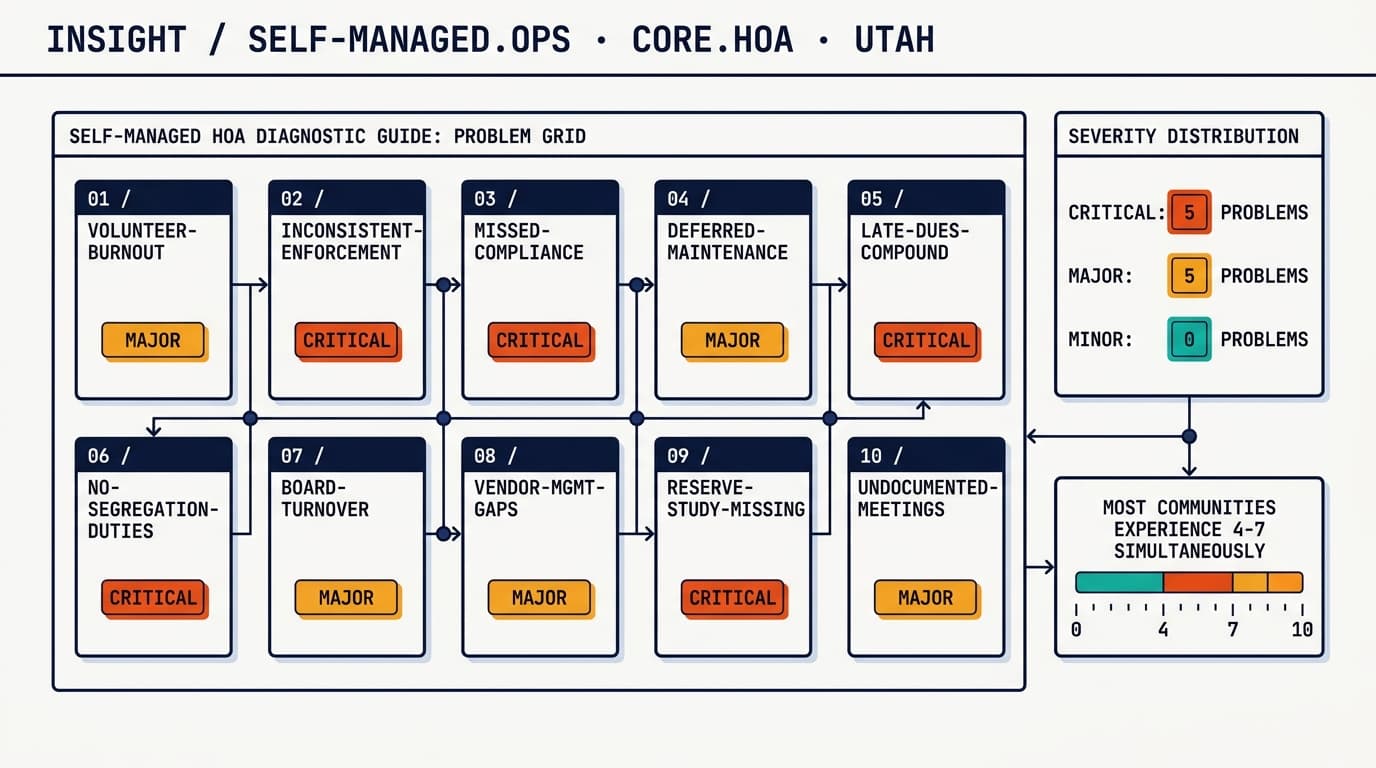
This is the diagnostic. The ten most common operational problems in self-managed HOAs, ranked by severity. For boards that want to know what they're dealing with — and which problems can be solved without changing management structure versus which problems are signals that the structure has outgrown self-management.
How to read this list
Each problem includes:
- What it looks like — how the problem actually manifests in the community
- What causes it — the underlying structural issue
- Severity —
CRITICAL(creates legal or financial exposure),MAJOR(creates operational drag), orMINOR(creates inconvenience) - What a self-managed board can do about it — fixes that don't require switching to professional management
- When it's a signal to switch — the threshold at which the problem indicates the community has outgrown self-management
The ten problems below are not ordered by severity. They're ordered by frequency — how often Core HOA encounters them in proposal-stage diagnostics across the Wasatch Front.
Problem 1 — Volunteer burnout
Severity: MAJOR
What it looks like. The board president is answering homeowner emails at 11pm. The treasurer is reconciling QuickBooks during their lunch break. The same three people have been on the board for six years because nobody else will run. New volunteers join enthusiastically and quit within twelve months.
What causes it. Volunteer time is finite. The operational workload of running an HOA — financial management, vendor coordination, compliance tracking, homeowner communication, meeting facilitation — exceeds what volunteer time can sustain in any community larger than about 25 doors. The community keeps growing or aging; the volunteer hours don't.
What a board can do. Recruit more committee members to spread the load. Document procedures so new volunteers can ramp faster. Outsource specific functions (accounting, legal review) even while staying self-managed overall. Set explicit term limits to prevent the same people from carrying everything indefinitely.
Signal to switch. When recruiting new board members has become structurally difficult, the community has run past the limits of volunteer governance. Switching to professional management isn't admitting failure — it's recognizing the math.
Problem 2 — Inconsistent enforcement
Severity: CRITICAL
What it looks like. One homeowner gets a violation letter for an unapproved fence. The next-door neighbor with a similar fence gets nothing. Some violations get enforced; others get ignored. Over time the CC&Rs feel like suggestions rather than rules.
What causes it. Volunteer boards struggle with enforcement because enforcement is uncomfortable. The volunteer next door doesn't want to be the person who fines their neighbor. Enforcement also requires a system — a reliable way to spot violations, a documented process for notification, and consistent escalation when violations aren't cured.
What a board can do. Adopt a formal enforcement policy with documented escalation steps. Apply it consistently. If the board can't bring itself to enforce against neighbors, hire an inspection service or compliance contractor to handle the enforcement role.
Signal to switch. When inconsistent enforcement has created legal exposure (a homeowner alleges discrimination based on selective enforcement) or when the board has stopped enforcing entirely because nobody wants the conflict, the community needs the buffer that professional management provides.
Problem 3 — Missed compliance deadlines
Severity: CRITICAL
What it looks like. The annual report to the state lapses. The insurance renewal deadline passes without market check. The audit doesn't happen because nobody scheduled it. The CC&R amendment that was supposed to be filed last spring is still on someone's desk.
What causes it. No single person owns the compliance calendar. Filings get tracked in someone's email or someone's memory. The treasurer knows about the audit; the secretary knows about the annual report; nobody knows about all of them. When that person rotates off the board, the institutional knowledge walks out.
What a board can do. Build a written 12-month compliance calendar. Assign every recurring obligation to a named role with a backup. Review the calendar at every monthly board meeting. Use any of the available HOA software tools that include compliance calendaring.
Signal to switch. When a missed deadline has produced a fine, a denied claim, or a legal exposure, the community has paid the cost of compliance failure once. Professional management exists to prevent the second occurrence.
Problem 4 — Deferred maintenance backlog
Severity: MAJOR
What it looks like. The asphalt that needed sealing two years ago and now needs replacement. The exterior paint that was supposed to be on a five-year cycle but is now eight years old. The landscape irrigation that's been patched four times because nobody approved the full repair.
What causes it. Maintenance gets deferred when there's no rhythm for surfacing it. Volunteer boards make maintenance decisions reactively — when a homeowner complains, when a vendor flags an issue, when something visibly fails. Without scheduled inspections feeding a tracked condition baseline, small issues compound into expensive ones.
What a board can do. Implement a scheduled inspection rhythm. Document condition of major components annually. Build a multi-year capital plan tied to the reserve study. Make maintenance decisions on the cycle, not in reaction to complaints.
Signal to switch. When the deferred maintenance backlog has grown to the point that a special assessment is the only way to catch up, the community needs operational depth that goes beyond volunteer scheduling. The cost of getting maintenance right is paid in scheduling discipline; the cost of getting it wrong is paid in dollars.
Problem 5 — Late dues compounding
Severity: CRITICAL
What it looks like. Three to eight percent of homeowners are chronically behind on dues. The treasurer sends reminder emails inconsistently. Some delinquencies get followed up; others get forgotten. Late fees are assessed sometimes and waived sometimes. Liens never get filed because nobody knows the procedure.
What causes it. Collections is uncomfortable, procedurally complex, and has high consequences for getting it wrong. Volunteer treasurers reasonably hesitate to file liens against neighbors. The community's CC&Rs probably authorize a clear collection process; the procedural execution is the missing piece.
What a board can do. Implement a documented collection cadence — friendly reminder at day 15, formal notice at day 45, attorney letter at day 75, lien filing at day 90. Apply the same process to every delinquency without exception. Use community counsel for the legal stages. See How to Handle Late HOA Dues for the full process.
Signal to switch. When chronic delinquency is above 5% or when the cumulative impact of uncollected dues has affected the community's ability to fund operations or reserves, professional collections management often pays for itself within a year through improved recovery.
Problem 6 — No segregation of duties in financial controls
Severity: CRITICAL
What it looks like. The same person collects checks, deposits them, reconciles the bank statement, and approves vendor payments. There are no second signatures on disbursements above a threshold. Bank reconciliations are months behind. Nobody outside the treasurer has visibility into the financial accounts.
What causes it. The volunteer treasurer is doing everything because there's no one else to share the work with. Even when the structure exists in CC&Rs (dual signatures required, monthly reports to the board), it gets relaxed in practice because following the structure adds friction.
What a board can do. Adopt a written financial controls policy that mandates segregation. Require two signatures on disbursements above a community-defined threshold. Have the bank send statements directly to a second board member as a check on reconciliation accuracy. Conduct an annual external audit even if not legally required.
Signal to switch. This problem is the highest-risk on the list. Communities without segregation of duties have experienced embezzlement; communities without external audits have discovered the embezzlement years after it began. Any board that recognizes this pattern in their own community should treat it as a structural problem requiring immediate professional involvement.
Problem 7 — Board turnover with lost institutional knowledge
Severity: MAJOR
What it looks like. The new board takes over and discovers there's no documentation of past decisions. The vendor relationships exist in someone's address book that left when they did. The reserve study is on a USB drive in a desk that nobody has access to anymore. Every two years the new board has to rebuild context from scratch.
What causes it. Self-managed communities don't have a continuous operational layer that persists across board turnover. Knowledge lives with individuals; when individuals rotate, knowledge rotates with them.
What a board can do. Build a community shared drive with structured folders for governance documents, vendor contacts, financial records, meeting minutes, and reserve studies. Mandate that all board work product gets stored there. Run a structured handover process when board members rotate.
Signal to switch. When board turnover is high enough that institutional knowledge cannot be sustained even with documentation, the community needs an operational layer that doesn't depend on volunteer continuity. A management firm provides that layer; the firm persists across board changes by design.
Problem 8 — Vendor management without competitive bidding
Severity: MAJOR
What it looks like. The same landscaper has had the contract for twelve years. Nobody remembers the last time the contract was bid. Vendor invoices come in and get paid because that's how it's always worked. The board has no benchmark for whether the rates are competitive.
What causes it. Competitive bidding is procedurally heavy. Writing a scope of work, soliciting bids, evaluating proposals, and switching vendors requires time and confidence that volunteer boards often don't have. The path of least resistance is to keep the existing vendor.
What a board can do. Establish a policy that contracts above a defined threshold get re-bid every three to five years. Use community-management trade associations or peer communities to source vendor candidates. Run a structured RFP process even if it's just two or three vendors.
Signal to switch. When the board can't reasonably evaluate whether vendors are competitive, the community is paying the "incumbent vendor premium" without knowing it. Professional management firms run vendor competitive processes routinely as part of standard service. The savings often exceed the management fee.
Problem 9 — Missing or outdated reserve study
Severity: CRITICAL
What it looks like. The community has a reserve study from 2017 that nobody has updated. Or the community has never had a reserve study. Or there's a study but the contributions haven't been recalibrated to match its recommendations. The board is operating without the data needed to make defensible reserves decisions.
What causes it. Reserve studies cost $2,500-$6,000 and feel like discretionary spending. Updating them every three to five years feels even more discretionary. Volunteer boards facing budget pressure often defer the study, which means the data deteriorates over time.
What a board can do. Commission a reserve study if the community has never had one. Refresh it every three to five years. Recalibrate annual contributions to match the study's recommendations. See How Salt Lake City Boards Can Tell If Reserves Are Underfunded for the diagnostic.
Signal to switch. When the community is materially underfunded and the board can't realistically run the recovery plan (phased contribution increases, special assessment communications, reserve study refresh) on volunteer time, professional management is often the path that makes the recovery feasible.
Problem 10 — Meetings that don't produce documented decisions
Severity: MAJOR
What it looks like. Board meetings run long, cover many topics, and end without clear next steps. Decisions are made informally, often after the meeting via email. Minutes are sparse and don't reflect specific decisions or assignments. Six months later, nobody can remember whether the board approved the project or just talked about it.
What causes it. Running structured meetings with documented decisions requires meeting facilitation discipline that volunteer boards often don't have. The meeting becomes a discussion forum rather than a decision body. The discussion has value but doesn't substitute for documented governance.
What a board can do. Adopt a structured agenda template. Distinguish discussion items from decision items. Require formal motions and votes on decisions. Distribute minutes within 7-10 days of each meeting. Have a board member specifically responsible for meeting facilitation rather than letting the role default to whoever speaks loudest.
Signal to switch. When the board can't reliably document its own decisions, the community is exposed to legal and operational risk. Decisions made informally are decisions that can be challenged. Professional management firms typically include structured meeting facilitation as part of standard service.
How to use the list
Three ways a board can apply this diagnostic:
-
Self-assessment. Run through the ten problems and mark which ones the community is experiencing. Most self-managed HOAs experience 4-7 of them at once. The count itself is a signal.
-
Severity check. Flag any
CRITICALproblems the community is experiencing. These are the ones with legal or significant financial exposure. Boards experiencing two or moreCRITICALproblems simultaneously should treat it as a structural signal, not a list of items to fix sequentially. -
Trend assessment. Compare today's count to twelve months ago. A community where the problem count is shrinking (board is solving things) is in a different position than a community where the count is growing (problems are compounding faster than the board can solve them).
The framework isn't designed to push every self-managed HOA toward professional management. Many self-managed HOAs are running well and should keep doing what they're doing. The framework is for the boards that suspect they're falling behind and want a structured way to test the hypothesis.
For deeper analysis on the question of when self-management has run its course, see When Should a Self-Managed HOA Hire a Management Company.
How Core HOA approaches the transition from self-managed
Core HOA's Financial tier ($200 base + $7 per door) was built specifically for self-managed communities that want to professionalize specific functions while retaining operational control. The math is honest: most self-managed HOAs benefit from professional financial management long before they need full-service. Books, collections, reserves modeling, and reporting run on the intelligence layer; everything else stays with the board.
For communities that have moved past self-management entirely, Core HOA's Standard tier ($300 base + $15–$18 per door) handles the full operational scope. The transition itself runs 60-90 days with documented onboarding — homeowner portal activation, financial records ingestion, compliance audit, vendor coordination handover, first board meeting under our facilitation.
Either way, the framework above is the diagnostic that tells the board what they're actually facing. The right answer for your community might be to keep self-managing with better systems, hire a financial-only firm, or move to full-service. The point of the diagnostic is to answer that question with data, not assumption.
Frequently asked questions
What are the most common problems self-managed HOAs run into?
Volunteer burnout, inconsistent enforcement, missed compliance deadlines, deferred maintenance, late dues compounding, lack of segregation of duties in financial controls, board turnover with lost institutional knowledge, vendor management without competitive bidding, missing or outdated reserve studies, and meetings that don't produce documented decisions. Most self-managed HOAs experience several of these simultaneously.
Can a self-managed HOA succeed long-term?
Yes, smaller communities (under 25 doors) with stable boards, simple infrastructure, and engaged volunteers can self-manage successfully for years. The pattern that works includes documented procedures, consistent enforcement, professional support for specialized work (accounting, legal, reserves), and willingness to professionalize specific functions even while staying self-managed overall.
When should a self-managed HOA hire a management company?
When two or more of the following are true: chronic delinquency above 5%, deferred maintenance backlog growing year-over-year, board turnover making continuity impossible, compliance failures that have led to fines or legal exposure, or volunteer burnout severe enough that recruiting new board members has become difficult. These are signals the board has structurally outgrown self-management.
What's the difference between self-managed and professionally managed HOA?
Self-managed HOAs run operations through volunteer board members and committee participation. Professionally managed HOAs contract with a management firm for some or all operational work — financial management, vendor coordination, compliance tracking, communication infrastructure. Both can succeed; both can fail. The variable is whether the operational rhythm matches the community's complexity.
How much does it cost to switch from self-managed to professionally managed?
Utah HOA management fees typically run $15-$50 per door per month for full-service management, with financial-only or limited-service tiers available at lower rates. The transition cost is mostly absorbed by the management firm during onboarding — communities should expect 60-90 days of transition work but rarely pay separate transition fees with reputable firms.
Recognizing your community in this list?
If your board is experiencing four or more of these problems and wants a structured second opinion on whether self-management is still working, request a proposal. We'll send the math, not the marketing.
Marc Kennedy is the owner of Core HOA, a family-owned HOA management firm based in Cottonwood Heights, Utah. Core HOA has managed Utah communities for over twenty years across the Wasatch Front. Marc reads every email sent to marc@corehoa.com.