How to Handle Late HOA Dues: A Collection Process for Utah Boards
Late HOA dues compound. A single homeowner missing a month is a minor irregularity. A community with 8% chronic delinquency over five years has lost the equivalent of half a year's operating budget — money the reserves were supposed to receive, the vendors were supposed to be paid with, and the maintenance was supposed to be funded by. The math is unforgiving. The cure is procedural.
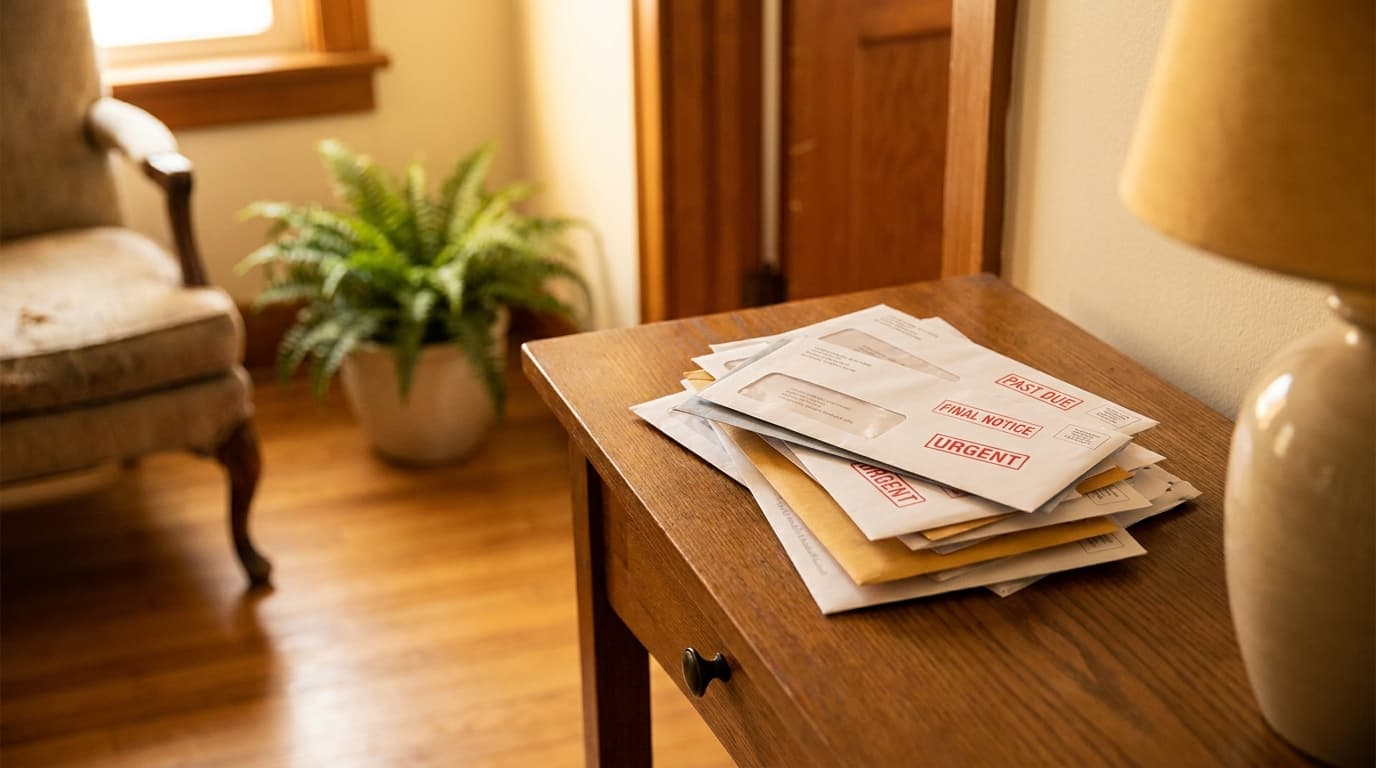
Most HOA boards know late dues are a problem and most HOA boards handle them inconsistently. The same delinquency that gets a polite email reminder in March gets ignored entirely in May because the volunteer treasurer was busy. By the time the board notices the pattern, the unit is six months behind, the late fees have stacked up, and the homeowner is either embarrassed into avoidance or actively resisting payment.
This guide is the structured process. How a Utah HOA should handle late dues from day zero through lien filing — the cadence, the letters, the legal posture, and the math that makes early action cheaper than late action.
Why the cadence matters more than the harshness
Boards sometimes ask whether collection should be aggressive or lenient. The framing is wrong. The variable that matters is consistency, not severity.
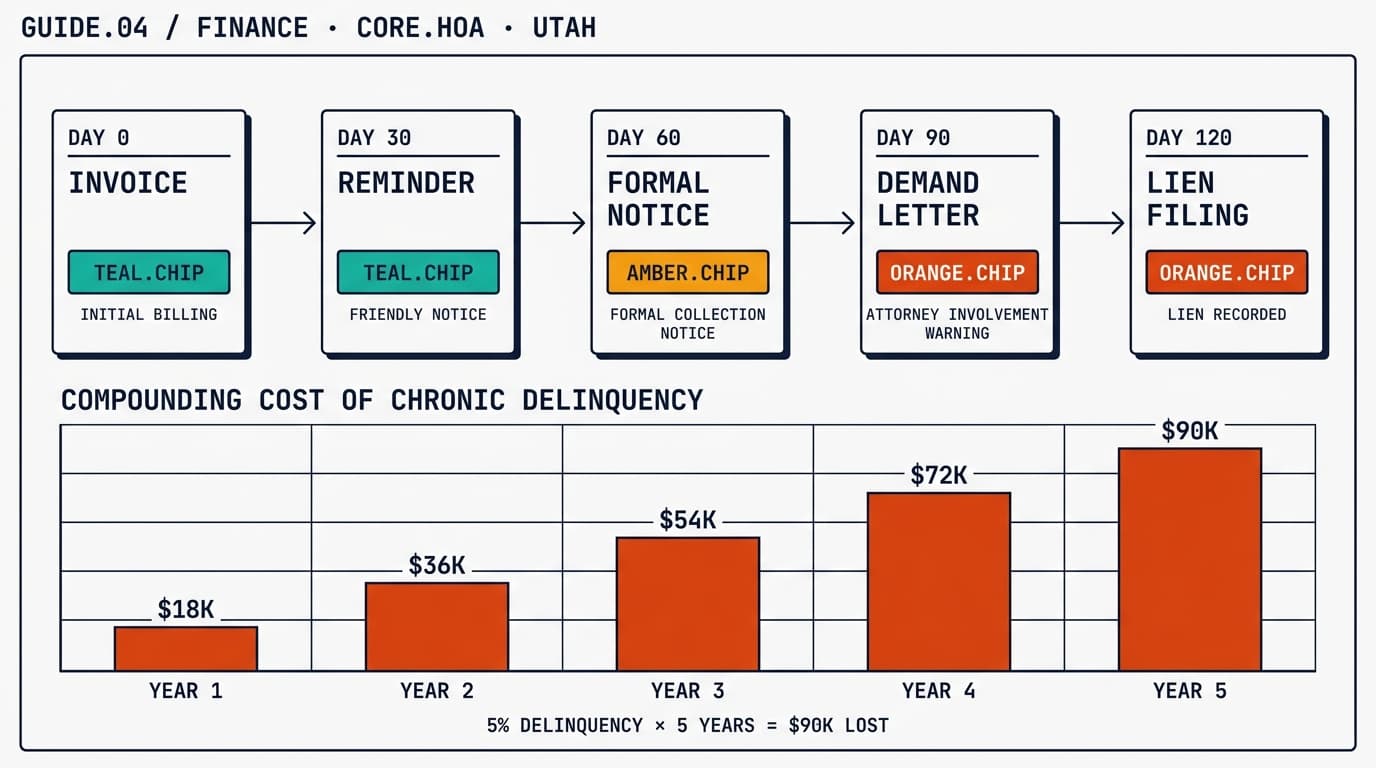
A predictable collection process — reminder at day 15, notice at day 45, demand at day 75, lien at day 90 — collects more than an inconsistent process that sends a harsh letter to one homeowner and ignores another for six months. Homeowners respond to predictability. The board that runs a clear, documented, evenly applied collection rhythm gets paid faster than the board that improvises.
There's also a fiduciary dimension. Boards that selectively enforce collections — going hard on some homeowners and soft on others — expose themselves to discrimination claims. Consistent application is both better collections practice and better legal posture.
The cadence below is the rhythm. Apply it the same way to every delinquency.
The four-stage collection process
Stage 1 — Day 15-30: Friendly reminder
Most missed payments aren't intentional. The auto-pay failed. The check got lost. The homeowner traveled and missed the due date. A friendly reminder at day 15-30 catches these cases without escalation.
The reminder should:
- Be sent in writing (email plus mail for important to ensure receipt)
- State the missed amount and the original due date
- Include a payment link or instructions
- Note the late fee that will assess at the next stage if payment isn't received
- Be friendly in tone — this is a reminder, not a demand
About 60-70% of late payments resolve at this stage. The board's job is to make payment easy, not to extract penance.
Stage 2 — Day 45-60: Formal collection notice
If the dues remain unpaid 30 days after the friendly reminder, the situation has moved from administrative oversight to a collections matter. The formal collection notice signals the shift.
The notice should:
- State the total balance due, including the original missed dues, the assessed late fees, and any applicable interest
- Reference the specific provisions of the community's governing documents authorizing late fees and collection action
- State the next step in the process and when it will trigger
- Include a payment plan option for homeowners experiencing temporary hardship
- Be sent via certified mail or other documented delivery method
This stage is procedurally important. The formal notice creates the documentary record needed for later stages. A board that skips from friendly reminder straight to lien filing has skipped the foundation that makes the lien defensible.
About 20-25% of remaining delinquencies resolve at this stage.
Stage 3 — Day 75-90: Attorney demand letter
If the balance remains unpaid 30 days after the formal notice, the board should engage qualified Utah counsel for a demand letter. The board itself does not write this letter. The community's attorney does.
The demand letter:
- Comes on the attorney's letterhead, signed by the attorney
- States the total balance, including accrued attorney fees if authorized in CC&Rs
- States explicitly that lien filing or other legal action will follow if the balance is not paid by a stated date
- References the specific Utah statutes and CC&R provisions authorizing further action
- Provides one final settlement opportunity, typically including the option for a payment plan with documented terms
The escalation to attorney involvement is the moment most remaining delinquencies resolve. Homeowners who ignored two prior notices respond when the next letter comes from a law firm.
About 10-15% of delinquencies that reached this stage resolve before the next step.
Stage 4 — Day 90-120: Lien filing
For balances that remain unpaid after the attorney demand letter, the board authorizes lien filing through counsel. The lien is filed with the county recorder's office in the county where the property is located.
The lien:
- Creates a public record of the unpaid balance
- Attaches to the property until paid
- Affects the homeowner's ability to refinance or sell the unit
- Establishes the basis for further legal action (foreclosure) if it becomes necessary
Most lien filings get paid within 90 days of filing because the homeowner cannot refinance, sell, or get clean title until the lien is satisfied. Foreclosure on an assessment lien is rare in practice — the lien itself does most of the collection work.
The board's role at this stage is to authorize the action through a documented board vote, follow counsel's guidance on procedure, and avoid commenting publicly about specific delinquencies. Confidentiality protects the board from defamation exposure and gives the homeowner a clean path to resolve without public embarrassment.
The math: why early action is cheaper than late action
Boards sometimes resist starting collections because the absolute dollars seem small. A single unit four months behind on $300/month dues is only $1,200. The collection costs feel disproportionate.
The math works differently in aggregate.
Consider a 100-door community with $300/month dues. Annual dues income at 100% collection: $360,000.
- 5% chronic delinquency: $18,000 lost per year. Over five years: $90,000.
- 8% chronic delinquency: $28,800 lost per year. Over five years: $144,000.
- 12% chronic delinquency: $43,200 lost per year. Over five years: $216,000.
The $216,000 over five years isn't a hypothetical. It's a roof replacement that the reserves now can't fund. It's two years of vendor cost increases that the budget can't absorb. It's a special assessment the board has to call on the unit owners who paid on time to cover the unit owners who didn't.
Early collection action — a reminder at day 15, a notice at day 45, an attorney letter at day 75 — typically costs $100-$300 per unit in process and legal fees. The cost of skipping the process is orders of magnitude higher. The math always favors structure.
What governing documents and Utah law require
The collection process described above must operate within the community's specific governing documents and applicable Utah law. Boards should:
-
Read the CC&Rs. Late fees, interest rates, lien rights, and collection procedures are typically defined in the CC&Rs. The board cannot enforce remedies the governing documents don't authorize.
-
Reference the Utah Community Association Act. Utah Code Title 57 Chapter 8a establishes statutory framework for community associations. Specific lien procedures, notice requirements, and homeowner rights are defined here.
-
Engage Utah counsel for collection escalations. The attorney demand letter (Stage 3) and lien filing (Stage 4) should always involve qualified counsel familiar with Utah HOA law. The cost of getting these stages wrong is far greater than the cost of legal review.
-
Document everything. Every notice sent, every payment received, every conversation with the delinquent homeowner. The documentary record is what makes lien filing defensible if challenged.
-
Apply consistently. The collection process must be applied the same way to every delinquency. Selective enforcement creates legal exposure and undermines collection effectiveness.
When to bring in a professional management firm
Boards self-managing their collections often get the early stages right and the later stages wrong. The friendly reminder is easy to write. The attorney demand letter requires actual attorney involvement. The lien filing requires county recorder procedure familiarity. The foreclosure (rare but real) requires litigation capability.
A management firm with operational depth runs collections as a structured process. Reminders and notices go out on schedule without the treasurer having to remember. Attorney involvement is triggered automatically at the cadence point. Lien filings and payment plans get tracked in a system, not in someone's email. The board approves the process; the firm runs it.
For communities with chronic delinquency above 5%, professional collection management often pays for itself within a year through improved recovery. For communities with low delinquency, the value is more about board time saved than dollars recovered.
How Core HOA approaches collections
Collections at every Core HOA-managed community run on the same staged rhythm. Day-15 reminders go out automatically from the financial system. Day-45 formal notices follow a documented template approved by Utah counsel. Day-75 demand letters route through our attorney partners on community-specific letterhead. Day-90 lien filings get processed through the appropriate county recorder's office with proper documentation.
The board sees collections status on the cockpit in real time — every delinquency, what stage it's at, what the next action is, what the cumulative cost of delinquency has been. No surprises at quarterly meetings. No improvising. No selective enforcement.
This is what continuous financial intelligence does for collections. The boards that get it spend their meeting time on strategic decisions, not on chasing missed payments one homeowner at a time.
Frequently asked questions
How should an HOA collect late dues?
A staged process: friendly reminder at day 15-30, formal collection notice with late fees at day 45-60, demand letter with attorney involvement warning at day 75-90, and lien filing at day 90-120 if balance remains unpaid. The cadence matters more than the harshness — predictable, documented escalation collects more than harsh outliers.
When can an HOA file a lien for unpaid dues in Utah?
Utah HOAs typically have lien rights established in their CC&Rs and reinforced under Utah Code Title 57 Chapter 8a (Community Association Act). The exact timing varies by community governing documents, but most CC&Rs allow lien filing once a unit owner is 60-90 days delinquent and after proper notice has been delivered. Boards should consult community-specific governing documents and Utah counsel before filing.
What late fees can an HOA charge in Utah?
Late fees must be specified in the community's governing documents (CC&Rs or rules and regulations) and must be reasonable. Common Utah HOA late fee structures include flat per-month fees ($25-$50) or percentage-based fees (5-10% of monthly dues). Interest can be assessed separately if authorized in governing documents. Excessive late fees can be challenged in court and should be set at levels that survive a reasonableness test.
Can an HOA foreclose for unpaid dues in Utah?
Yes, Utah HOAs can foreclose on assessment liens, though the process is rarely used and requires careful adherence to statutory and contractual procedures. Most delinquencies resolve before foreclosure becomes necessary — through payment, settlement, or sale of the property. Foreclosure is typically a last resort after months of escalation and should always involve qualified Utah counsel.
How do late dues affect an HOA's finances?
Late dues create immediate cash flow gaps and longer-term reserves drag. A community with 5% chronic delinquency loses 5% of its budget every year — money that was meant to fund operations and reserves. Compounded over five to ten years, that gap becomes deferred maintenance, special assessments, and reserve underfunding. Early collection action is the cheapest way to prevent the compounding. For Salt Lake Valley boards working through delinquency at scale, see our Salt Lake Valley HOA management pillar for the metro context.
Need help systematizing your collections?
If your board is handling late dues inconsistently or watching the math compound against you, request a proposal. We'll send the math, not the marketing.
Marc Kennedy is the owner of Core HOA, a family-owned HOA management firm based in Cottonwood Heights, Utah. Core HOA has managed Utah communities for over twenty years across the Wasatch Front. Marc reads every email sent to marc@corehoa.com.
This article provides general information about Utah HOA collection practices and is not legal advice. Boards should consult qualified Utah counsel for community-specific collection guidance.