
HOA Management Cost in Utah: What Boards Actually Pay in 2026
The question "how much does HOA management cost in Utah?" has a real answer and a misleading answer. The misleading answer is the per-door rate from a sales proposal — the number boards focus on when comparing firms because it's the only number visible at first read. The real answer is total cost of ownership: the per-door rate plus every ancillary fee, vendor markup, compliance penalty, and operational gap that determines what the community will actually pay over the contract term.
A community comparing two firms — Firm A at $20 per door per month, Firm B at $28 per door per month — might assume Firm A is the cheaper option. The math often works the other way once Firm A's per-meeting fees, per-violation letter charges, and 25% undisclosed vendor markup come into the calculation. The cheaper sticker price hides the more expensive total cost.
This guide is the breakdown. What Utah HOA management actually costs in 2026, what fee structures look like across firms, and the specific math boards should run when comparing proposals — so the right firm gets hired for the right reasons.
The headline numbers
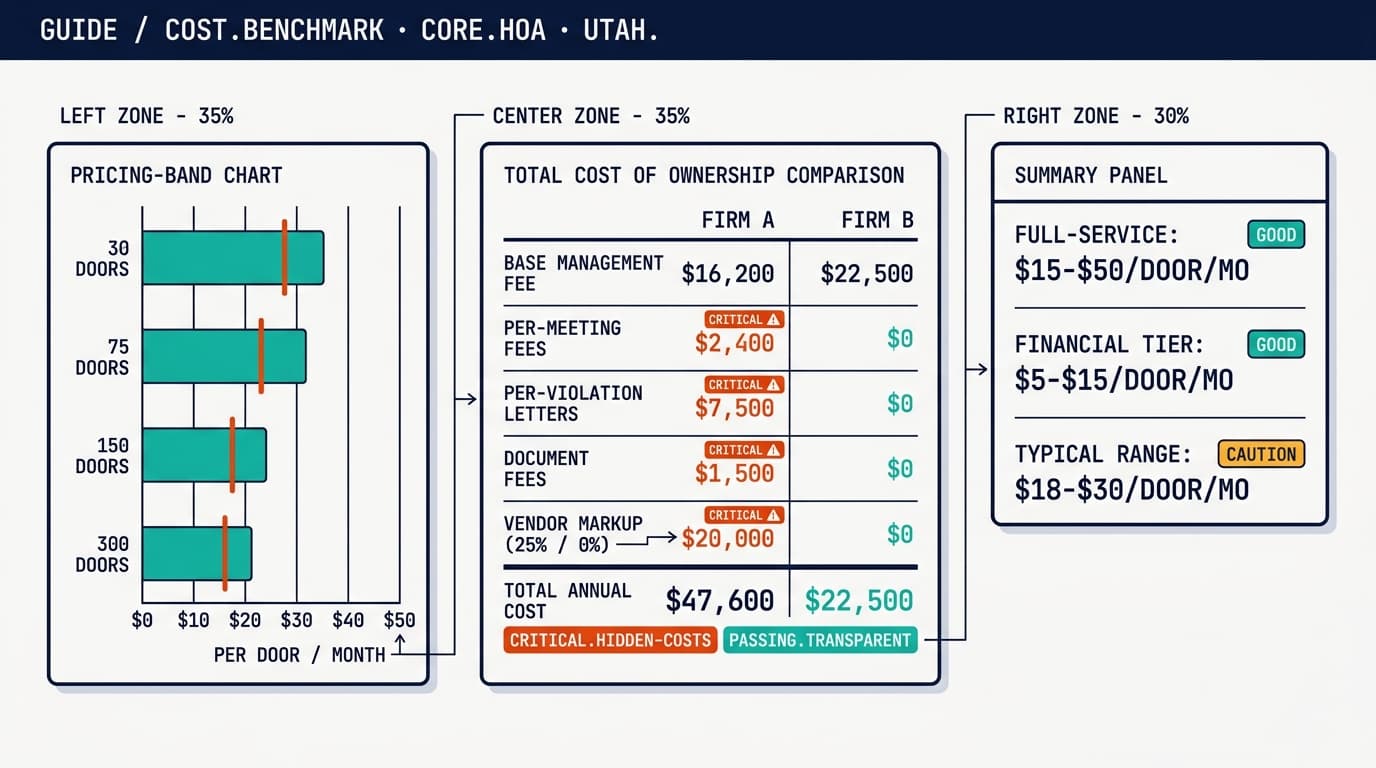
For context, here's where 2026 Utah HOA management pricing falls based on publicly available proposals across the Wasatch Front and national surveys:
Full-service HOA management: $15-$50 per door per month, with most communities paying $18-$30 Financial-only / limited-service tiers: $5-$15 per door per month Base flat fee component (when present): $150-$400 per month, usually layered on top of per-door pricing Ancillary fees, when itemized: $50-$500 per violation letter, $100-$500 per board meeting beyond a baseline allowance, $200-$2,000 for project management on capital work
The wide range reflects three things: differences in actual service scope (a "full-service" firm at $18 per door is providing a different bundle than a "full-service" firm at $35 per door), differences in community complexity (a 30-door condominium with shared mechanical systems costs more to manage than a 30-door PUD with no common amenities), and differences in how aggressively firms charge ancillary fees on top of the base rate.
The ranges above are directional. Specific firms charge more or less; Marc has seen quotes outside both ends of the band depending on community circumstances and firm positioning.
How HOA management fees are typically structured
Three structural patterns dominate Utah HOA management pricing.
Per-door only
The simplest model. The community pays a monthly fee per door — typically $15-$50 — that covers all standard service. No flat base fee, no separate ancillary charges for routine work.
This model is usually offered by firms confident enough in their service scope to bundle everything into a single number. It's the easiest to compare across firms because there's only one variable. It's also the model most likely to provide cost certainty for the board — what they pay in month one is what they pay in month twelve.
Base + per-door
A monthly flat fee ($150-$400) plus a per-door charge ($10-$30). The flat fee covers fixed overhead — the manager's allocated time, technology platform costs, administrative overhead. The per-door charge scales with community size to capture variable costs.
This model is common for firms managing communities of varied sizes. The flat fee floor ensures small communities aren't subsidized by the firm; the per-door scales appropriately for larger ones.
The math at typical breakpoints:
- 25-door community: $200 base + $25/door = $625/month total = $25/door effective
- 50-door community: $250 base + $20/door = $1,250/month total = $25/door effective
- 100-door community: $300 base + $18/door = $2,100/month total = $21/door effective
The effective per-door rate generally decreases as community size grows because the flat fee gets spread across more units.
Per-door plus extensive ancillary fees
A lower base per-door rate ($15-$22) combined with per-event fees for many services. Per-meeting charges, per-violation charges, per-document charges, project-by-project charges.
This is the model that produces the most volatile total cost of ownership. The sticker price looks competitive; the actual annual cost depends on how often the firm bills additional charges.
A 75-door community at $20 per door per month would pay $18,000 in base management fees annually. The same community could easily pay $5,000-$15,000 more per year in ancillary charges depending on the firm's fee schedule and the community's volume of meetings, violations, and projects.
What's actually included at typical price points
The variable that boards under-evaluate is service scope. A $20 per-door fee from one firm is not the same as a $20 per-door fee from another firm. Here's what's typically included at different price points based on publicly available Utah HOA management proposals.
$15-$20 per door per month
Usually includes: monthly financial close, basic financial reporting, accounts payable, dues collection, basic compliance tracking, board meeting attendance (limited count), homeowner inquiry response.
Often excludes: detailed compliance calendar management, proactive vendor coordination, scheduled maintenance inspections, project management on capital work, board training and onboarding, advanced reporting, real-time portal access.
Firms in this range are typically running thin operations and recovering margin through ancillary fees and vendor markup. Communities pay a low sticker price and a higher total cost.
$20-$30 per door per month
Usually includes: full financial management with monthly close and audit support, structured compliance calendar, vendor coordination with documented bidding, scheduled maintenance inspection, board meeting facilitation (including special meetings), homeowner portal with payment and request submission, board reporting infrastructure.
Often excludes: extensive capital project management, after-hours emergency response (sometimes upcharged), specialized communications.
This is the range where most genuinely full-service Utah HOA management firms operate. The economics work because the base fee covers the actual operational scope rather than counting on ancillaries.
$30-$50 per door per month
Usually includes: everything above plus extensive capital project oversight, premium portal experiences, advanced reporting and analytics, dedicated manager rather than portfolio manager, after-hours and emergency response built in.
Found primarily in: complex communities (high-rise condominiums, multi-association master-planned developments), communities with extensive amenities (pools, clubhouses, on-site staff coordination), or smaller communities where the per-door math has to support meaningful operational depth.
Above $50 per door per month
Usually reflects: very small community with high per-door math (15-door condominium with elevators, for example), high-touch service tier, or specialized circumstances. Boards seeing quotes above this range should verify what specifically is being purchased.
The hidden costs to add to the sticker price
Total cost of ownership requires adding several costs that don't appear on the per-door rate.
Ancillary fee exposure
For firms that charge ancillary fees, calculate the expected annual addition based on the community's typical activity:
- Per-meeting fees: estimate 8-12 board meetings annually, plus 2-4 special meetings. At $200/meeting, that's $2,000-$3,200/year.
- Per-violation letter fees: estimate 0.5-2 violations per door per year. At $100/letter for a 75-door community, that's $3,750-$15,000/year.
- Document production fees: estimate $500-$2,000/year depending on community sales volume.
- Project management fees: 5-15% of project costs on capital work. Variable by year.
A firm with a $20 per-door base and full ancillary charges can easily add $10,000-$30,000 per year in fees that don't appear on the proposal headline.
Vendor markup exposure
Some firms charge vendor markup that doesn't appear in the management fee at all — it shows up in vendor invoices passed through to the community. Industry-typical markup ranges from 0% (pass-through at cost) to 30%.
For a 75-door community spending $80,000 per year on outside vendors (landscaping, maintenance, repairs, insurance), a 20% markup means $16,000 per year flowing to the management firm without appearing on the management fee line.
This is the largest single hidden cost in HOA management pricing and the one boards most often miss when comparing firms. Always ask the question explicitly: "What's your vendor markup policy?" The answer should be a specific number or a clear pass-through statement.
Operational gap costs
The hardest cost to quantify but often the largest. When a firm with thin operational depth misses a compliance deadline, fails to surface a maintenance issue early, or doesn't run vendor competitive bidding, the community pays the cost in dollars or risk exposure.
These costs are real but invisible at proposal stage. The way to estimate them is to look at the firm's operational rhythms — described in The Myth of Full-Service HOA Management — and assess whether the firm has the depth to prevent the gaps.
How to run a real apples-to-apples comparison
When comparing two or more HOA management proposals, normalize the comparison this way:
Step 1 — Establish base management cost. Per-door rate × number of doors × 12 months. Add any base flat fee × 12 months.
Step 2 — Add ancillary fee exposure. Estimate the firm's expected annual ancillary charges based on community activity (meetings, violations, document requests, project volume).
Step 3 — Add vendor markup exposure. Total annual vendor spend × the firm's markup percentage. (If the firm refuses to disclose markup, treat this as a major risk and weight accordingly.)
Step 4 — Adjust for service scope. If one firm includes services another firm bills separately, adjust the comparison so both firms are quoted for the same scope.
Step 5 — Compare total annual cost of ownership, not sticker price.
Worked example: A 75-door community comparing two firms.
| Component | Firm A | Firm B | |---|---|---| | Base management fee (75 doors × 12 months) | $18 × 75 × 12 = $16,200 | $25 × 75 × 12 = $22,500 | | Per-meeting fees (12 meetings × $200) | $2,400 | $0 (included) | | Per-violation letters (50 letters × $150) | $7,500 | $0 (included) | | Document production fees | $1,500 | $0 (included) | | Vendor markup (on $80K vendor spend) | 25% = $20,000 | 0% = $0 | | Total annual cost of ownership | $47,600 | $22,500 |
Firm A's $18 per-door rate produces $47,600 in annual cost. Firm B's $25 per-door rate produces $22,500 in annual cost. The firm with the higher sticker price costs the community half as much in total.
The exact numbers vary by community but the structure of the math doesn't. Sticker price is a misleading comparison; total cost of ownership is the only honest one.
Why management costs feel high in absolute terms
Management fees feel expensive because the absolute dollars are large. A 100-door community paying $25 per door per month is paying $30,000 per year. That number lands hard at a board meeting where reserves are already tight.
The right comparison isn't management fees against zero (the implicit comparison when boards reject professional management). It's management fees against:
- The cost of volunteer time spent on operations the firm would otherwise handle (often 10-20 hours per month across the board)
- The cost of vendor markup the community is paying without realizing it
- The cost of compliance failures, deferred maintenance, and reserve underfunding that operational depth prevents
- The cost of board burnout that produces high turnover and lost institutional knowledge
A 100-door community can easily incur $50,000+ per year in indirect costs from running self-managed or with a thin management firm. Against that, $30,000 in management fees from a firm with operational depth is often the cheaper option.
This isn't a sales pitch — it's the math. Some communities run self-managed and the math works. Many do not.
How Core HOA's pricing fits the framework
Core HOA's pricing model is base + per-door with no ancillary fees and full vendor pass-through.
Standard tier: $300 base + $15–$18 per door per month. Full-service operations including all the rhythms described in The Myth of Full-Service HOA Management. No per-meeting fees, no per-violation fees, no document production fees. Vendor invoices pass through at cost.
Financial tier: $200 base + $7 per door per month. Financial-only management for self-managed communities — accounting, collections, monthly close, reserves modeling, financial reporting. Operational scope stays with the board.
For the worked example above (75-door community), Core HOA Standard runs:
- $300 base × 12 = $3,600
- $15–$18 × 75 × 12 = $13,500–$16,200
- Total annual cost: $17,100–$19,800
Comparable to Firm B in the worked example, lower than Firm A once total cost of ownership is calculated.
This isn't a claim that Core HOA is the cheapest option for every community. The right question for any board isn't "which firm is cheapest?" — it's "which firm provides the operational depth our community needs at a defensible total cost?" The framework above is how a board answers that question with data.
Frequently asked questions
How much does HOA management cost in Utah?
Full-service HOA management in Utah runs $15-$50 per door per month, with most communities paying in the $18-$30 range. Financial-only or limited-service tiers run $5-$15 per door per month. The wide range reflects differences in service scope, community complexity, and how aggressively firms charge ancillary fees on top of the base rate. For metro-specific context, see our Salt Lake Valley HOA management pillar — the dollar bands above hold across the valley but the operating realities differ city by city.
What does HOA management fee per door include?
It varies by firm. A genuinely full-service per-door fee should include accounting, financial reporting, vendor coordination, compliance tracking, board meeting facilitation, homeowner communication, and administrative work. Many firms exclude some of these from the base fee and charge separately — per-meeting fees, per-violation letter fees, and document production fees are common ancillary charges.
Why is HOA management so expensive?
HOA management is labor-intensive: each community requires a manager who attends meetings, coordinates vendors, tracks compliance, and handles homeowner inquiries. The actual question is whether the management fee is expensive relative to the operational value provided. A firm with operational depth often saves the community more than the management fee through avoided vendor markup, prevented compliance failures, and faster issue resolution.
How do I compare HOA management firm pricing?
Compare total cost of ownership, not sticker price. Look at the base management fee, ancillary fees (per-meeting, per-violation, document fees), vendor markup policy, and what's included versus billed separately. A firm with a $25 per-door base fee and no ancillary charges often costs less than a firm with a $20 per-door base fee plus $200 per meeting and undisclosed vendor markup.
Should an HOA pay flat fee or per-door pricing?
Per-door pricing is the industry standard and generally fairer for both parties — costs scale with community size and service complexity. Flat fees can be appropriate for very small communities (under 20 doors) where per-door math produces uneconomic management fees. Either model can work; the question is whether the pricing structure aligns with the firm's actual cost to serve the community.
Want a real total-cost comparison?
If your board is comparing management firm proposals and wants an honest total-cost-of-ownership analysis, request a proposal. We'll send the math, not the marketing.
Marc Kennedy is the owner of Core HOA, a family-owned HOA management firm based in Cottonwood Heights, Utah. Core HOA has managed Utah communities for over twenty years across the Wasatch Front. Marc reads every email sent to marc@corehoa.com.