HOA Reserves Underfunded? How Salt Lake City Boards Can Tell
Your HOA's reserves are probably underfunded. Across Utah, most HOAs sit between 40% and 70% funded against the recommended balance from their last reserve study, and the gap is widening every year that contributions stay flat while replacement costs keep rising. The Salt Lake City market is no exception — if anything, the aging post-2000 housing stock in Salt Lake County puts more boards in the danger zone than they realize.
The trouble with reserve underfunding is that it's invisible until it isn't. The roof holds, the asphalt cracks but doesn't fail, the boiler runs another winter. Until one of them doesn't. Then the board gets a vendor quote that's three times the reserve balance, the math becomes obvious, and the only options left are special assessment or major dues increase. Both are bad. Both are preventable.
This guide is the diagnostic. How to tell where your community stands, what causes underfunding, and what recovery actually looks like — for boards that want to know the answer before the boiler decides for them.
What "underfunded" actually means
Reserves are the money set aside for major component replacements — roofs, asphalt, mechanical systems, elevators, painting, exterior surfaces — over the building's life cycle. They are not operating funds. They are not slush funds. They are a structured pool funded by monthly contributions, sized to replace the major components when they reach end-of-life.
A reserve study is the document that tells you how big that pool should be. A qualified reserve specialist inventories every major component, estimates remaining useful life, projects replacement costs, and calculates the contribution rate needed to fund replacements without special assessments.
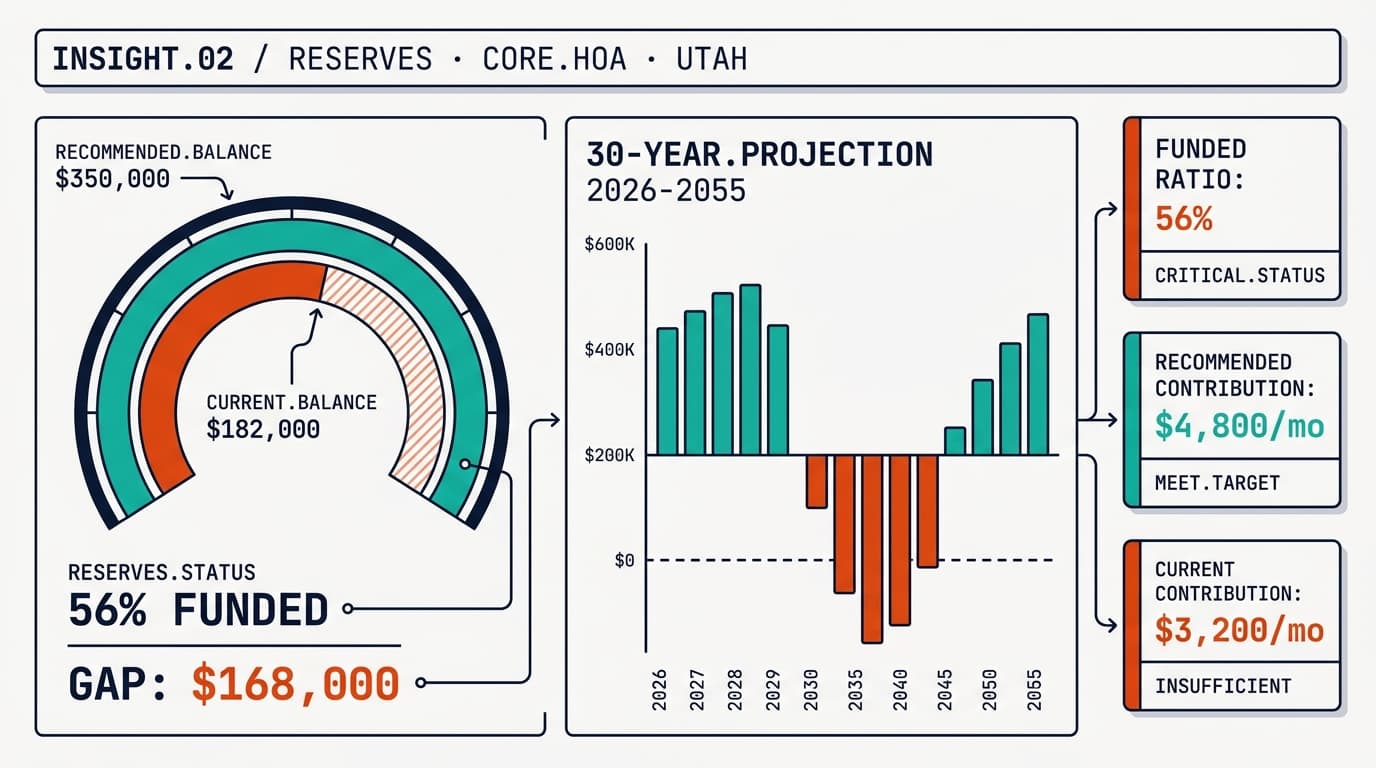
The "funded ratio" is the comparison. Current reserve balance divided by the recommended balance from the study. Expressed as a percentage.
- 100% funded — fully funded against the study's recommendation. The goal, rarely achieved.
- 70-100% funded — strong position. Special assessments unlikely barring extraordinary failures.
- 30-70% funded — moderate underfunding. Recovery possible but requires action.
- Below 30% funded — danger zone. A single major component failure becomes a special assessment.
Most Utah HOAs are in the 30-70% range. Some communities Marc has reviewed at proposal stage have been below 20%.
How to diagnose your community in 30 minutes
A board doesn't need to hire a consultant to get a first read on funded ratio. The diagnostic runs in 30 minutes with three documents.
Step 1 — Pull your most recent reserve study
If your community has had a reserve study in the last five years, it's on file somewhere — usually with the management firm, sometimes in the board's shared drive. The study contains a recommended reserve balance for the current year, calculated from the inventory of components and their remaining useful lives.
Find the line that says "fully funded balance" or "recommended balance" for the current year. That's the denominator.
If your community has never had a reserve study, or your last one is more than five years old, you've found your first answer: you don't know your funded ratio because the data doesn't exist. That itself is a finding. Reserve studies should be updated every three to five years to track inflation, component condition changes, and useful-life refinements.
Step 2 — Pull your current reserve account balance
This number lives in your monthly financial reports or your management firm's portal. It's the actual cash in the reserve account today.
Don't confuse this with the operating account balance. Operating funds pay vendors and salaries. Reserves pay for component replacements. Mixing them is a sign of either sloppy bookkeeping or worse.
Step 3 — Compute the funded ratio
Current reserve balance ÷ Recommended balance × 100 = Funded ratio
Example: a 100-door condominium community with a current reserve balance of $214,000 and a recommended balance from the study of $382,000 has a funded ratio of 56%.
That community is materially underfunded. Not catastrophically — there's still time to recover — but the gap is real and growing.
The three causes, almost always all three
Once you have the funded ratio, the next question is how the community got there. Three causes account for almost every underfunded HOA in Utah.
Cause 1 — Past boards under-contributed
The most common cause. A board ten or fifteen years ago made a judgment call: keep monthly dues low to avoid homeowner pushback, contribute less than the reserve study recommended, deal with the gap "later." Later arrived. The current board inherits the gap.
This isn't anyone's fault, exactly. The previous board faced real political pressure to keep dues affordable. The current board is dealing with the consequences of decisions made by people who are no longer in the room.
Cause 2 — Reserve studies were never updated
A reserve study from 2018 was based on 2018 component costs. A roof replacement that cost $180,000 in 2018 costs closer to $290,000 in 2026. If the study was never refreshed, the recommended reserve balance is calibrated to outdated numbers. The community can be 100% funded against an obsolete study and 60% funded against current reality.
This cause hides the funding gap rather than creating it. The board thinks they're in good shape because they're meeting an old target. The actual gap doesn't surface until the bid for replacement comes in and the math fails.
Cause 3 — Major components are aging in unison
In communities built within a narrow window — most of post-2000 Salt Lake Valley condominium developments fit this pattern — major components reach end-of-life around the same time. The roofs, the boilers, the asphalt, the exterior paint, all installed within a few years of each other, all reaching 20-25 year service life within a few years of each other.
Reserves designed assuming staggered replacements get exhausted faster than expected when replacements stack up. A community contributing adequately for one component at a time can fall behind quickly when three components need replacement in the same five-year window.
Most underfunded communities have all three causes operating at once. Underfunded since inception, working from outdated studies, and now hitting the simultaneous-replacement wall.
What recovery actually looks like
Recovery from underfunding is mathematically possible if the community has time. It's mathematically impossible if the major components are reaching end-of-life faster than contributions can refill the gap.
The phased contribution increase path
For communities 50-70% funded with most major components more than five years from replacement, recovery runs through a phased contribution increase. The board updates the reserve study to current cost data. The new study recalculates the recommended contribution rate. The board phases in the increase over two to four years, communicating the math clearly to homeowners and tying each phase to specific component plans.
This path works because compounding contributions over a 5-10 year horizon can close even significant gaps. It requires homeowners willing to absorb dues increases, which requires a board willing to defend the math.
The special assessment path
For communities below 50% funded, or with major components failing within the next two to three years, recovery typically requires a special assessment. The math doesn't work otherwise. Ten years of contribution increases cannot fund a roof that needs replacement next year.
Special assessments are politically expensive but mathematically necessary in these cases. The board's choice isn't whether to assess — it's whether to assess proactively (with planning, vendor competition, and clear communication) or reactively (after a component failure forces an emergency assessment with no time for proper procurement).
Proactive assessments cost less and damage trust less than reactive ones. The math is the same; the planning rhythm is different.
The hybrid path
Most communities recover through a combination — a moderate special assessment to fund the most urgent component replacements, paired with a phased dues increase to rebuild long-term reserves. This is uncomfortable. It is also, for many communities, the only path that's both mathematically sound and politically survivable.
What a board should do this quarter
Three actions, in order of priority:
Action 1 — Get the diagnostic done. Run the 30-minute funded-ratio calculation. If you don't have a current reserve study, commission one this quarter. The cost of a reserve study for a typical Utah condominium community runs $2,500-$6,000 — small money against the cost of being wrong about your reserve position.
Action 2 — Surface the math to the full board. Reserve underfunding is often invisible to board members who haven't looked at the numbers. Bring the funded ratio to the next board meeting. Get all directors aligned on what the data says before any homeowner conversations begin.
Action 3 — Communicate the trajectory, not the panic. Underfunded reserves are common, recoverable in many cases, and best discussed in measured terms. Homeowners can absorb difficult news framed as a multi-year recovery plan. They cannot absorb difficult news framed as crisis. The board's job is to translate math into trajectory.
How Core HOA approaches reserve work
Reserve work runs on a continuous rhythm at every Core HOA-managed community. Reserve studies are commissioned every three to five years, updated for inflation between formal refreshes, and tracked against actual contributions monthly. Funded ratios appear on the board cockpit in real time. Component-replacement timelines are forecasted on a 12-month and 5-year horizon. When a community is drifting toward underfunding, the drift surfaces months before it becomes a board agenda item.
This is what the intelligence layer actually does for reserves. Continuous monitoring instead of quarterly check-ins. The math, available the moment a board member needs it. Drift caught at the rhythm, not at the failure.
Frequently asked questions
How do I tell if my HOA reserves are underfunded?
Compare your current reserve balance against the recommended balance from your most recent reserve study. If you're below 70%, you're materially underfunded. If you're below 50%, you're in the danger zone where a single major component failure becomes a special assessment. If you don't have a reserve study, you don't know either way — and not knowing is itself a sign of underfunding.
What percentage funded should an HOA reserve be?
Industry guidance from organizations like CAI suggests 70% funded is the threshold for low risk, with 100% funded being the goal. Most Utah HOAs sit in the 40-70% range. The funded ratio matters less than the trajectory — a community at 60% funded with a clear path to 80% is in better shape than a community at 75% funded with no contribution increases planned.
What causes HOA reserves to become underfunded?
Three causes account for most underfunding. Past boards under-contributed to keep dues low. Reserve studies were never updated to reflect rising replacement costs. Major components reached end-of-life simultaneously, exhausting reserves faster than contributions could replenish them. Most underfunded communities have all three causes operating at once.
Can an HOA recover from underfunded reserves without a special assessment?
Sometimes, depending on how deep the gap is and how much time the major components have left. A community 70% funded with most components more than five years from replacement can recover through phased dues increases. A community 40% funded with components reaching end-of-life next year almost certainly cannot — a special assessment is the only realistic path.
Are HOA reserve studies required in Utah?
Utah does not currently require reserve studies for most HOAs by statute, unlike states such as California or Washington. However, lender requirements for FHA-approved condominium associations and prudent fiduciary practice both effectively require them. A board operating without a current reserve study is operating without the data needed to meet its fiduciary duty. For Salt Lake Valley boards specifically, see our Salt Lake Valley HOA management pillar for metro-level vendor cost context that affects every reserve calculation here.
Want a second opinion on your reserves?
If your board wants a structured review of where your reserves stand and what recovery would look like for your community, request a proposal. We'll send the math, not the marketing.
Marc Kennedy is the owner of Core HOA, a family-owned HOA management firm based in Cottonwood Heights, Utah. Core HOA has managed Utah communities for over twenty years across the Wasatch Front. Marc reads every email sent to marc@corehoa.com.