

The Myth of Full-Service HOA Management: Red Flags Boards Should Spot
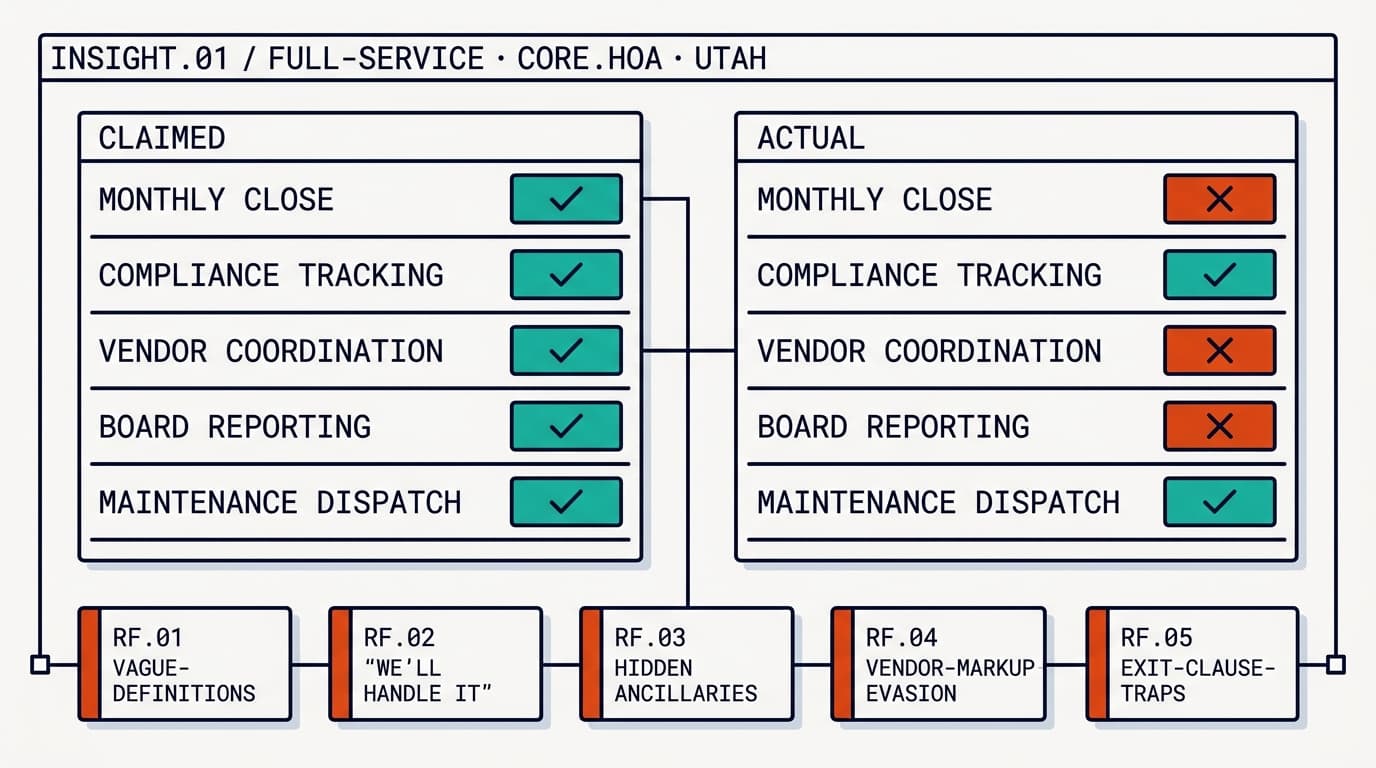
Most "full-service" HOA management isn't. The label is industry shorthand that has stopped meaning anything specific because every firm uses it and nobody defines it the same way. A board can sign with two different firms both marketing themselves as full-service and get fundamentally different operations — one with monthly closes and a 12-month compliance calendar, the other with quarterly closes and a manager who tracks compliance in their head.
The cost of the gap between full-service-as-marketing and full-service-as-operations isn't visible in the contract. It shows up over the next two to three years in deferred maintenance, missed renewals, surprise fees, and the slow recognition that the board is doing more work than it should be. By then the contract has another year to run.
This is the playbook for spotting the gap before signing — five red flags that separate firms running real full-service operations from firms selling the label.
Why "full-service" stopped meaning anything
The HOA management industry has no certifying body that defines "full-service" the way the medical industry defines specialties. There is no minimum operational standard. There is no required disclosure of what's included versus what's billed separately.
This isn't a complaint about the industry. It's a description of the operating environment boards are working in. Without a standard definition, the label gets used by firms running radically different operations. Two firms with identical "full-service HOA management" pitches can have:
- Monthly close vs. quarterly close
- 12-month compliance calendar vs. ad-hoc compliance tracking
- Pass-through vendor invoicing vs. 15-30% vendor markup
- 60-minute response SLA vs. "we'll get back to you"
- Direct owner access vs. seven-layer escalation tree
Both call themselves full-service. Only one of them is.
The myth, then, isn't that full-service management exists. It's that "full-service" on a sales deck tells you anything reliable about which firm you're getting. The label is too elastic to mean anything. The mechanisms underneath are what matter.
The five red flags
These appear in proposals, sales calls, and contracts. Some are obvious once you know what to look for. Some are buried in language that sounds reasonable until you read it twice.
Red flag 1 — Service descriptions without mechanisms
Watch for service descriptions that name a category without describing how the work runs.
Yes, this is a red flag:
"We provide comprehensive financial management including budgeting, accounting, and reporting."
No, this isn't a red flag:
"We run monthly close on the 5th of each month, deliver board financial packages by the 10th, and complete annual audits with a CPA partner by April 15. Variance analysis is included in every monthly package."
The first describes a category. The second describes a rhythm. A firm with operational depth answers the second way because that's how the work actually runs. A firm without operational depth answers the first way because category descriptions are easier to write than rhythm descriptions.
Red flag 2 — "We'll handle it" without specifying who
The phrase "we'll handle it" or "our team takes care of all that" is industry shorthand for "we don't have a defined accountability model." Real operational depth has named roles and named processes.
When the topic is compliance: who specifically tracks the calendar? When it's vendor coordination: who approves vendor selection and what's the documented threshold? When it's after-hours emergencies: which person is on call and how is that rotation maintained?
A firm that can answer these questions has operational structure. A firm that can't is improvising. Both can call themselves full-service. Only one of them is staffed for it.
Red flag 3 — Bundled language hiding ancillary fees
Read the proposal for any phrase that includes "additional fees may apply," "as needed," "scope of separate engagement," or "billed separately." Then ask which specific services those phrases attach to.
Common ancillary fees that get hidden in full-service proposals:
- Per-violation letter fees ($50-$500 per letter)
- Per-meeting fees beyond a baseline allowance
- Special meeting fees
- After-hours dispatch fees
- Document production fees (CC&Rs, financial reports for refinances or sales)
- Setup fees for new technology features
- Project management fees on capital projects
A firm running genuinely full-service operations bundles most of these into the base management fee. A firm using full-service as marketing language itemizes them separately and counts on the board not noticing until invoices arrive.
Red flag 4 — Vendor markup evasion
Vendor markup is the percentage a management firm adds to vendor invoices before passing them to the HOA. Some firms charge zero markup and treat vendor coordination as part of the management fee. Some firms charge a flat percentage, disclosed openly. Some firms charge a markup they refuse to disclose.
The third pattern is the red flag.
Ask the question directly: "What's your vendor markup policy?" The answer should be a specific number or a clear pass-through statement. Any answer that includes "it depends," "we don't really mark up," or "you'll see the invoices yourself" is hiding something.
A firm running 20% markup on vendor invoices for a 75-door community can be extracting an extra $15,000-$30,000 per year that the board doesn't see in the management fee line. That's real money. The disclosure is the difference between a firm doing transparent work and a firm running a profit center the board doesn't know about.
Red flag 5 — Exit clauses that hold the data hostage
The exit clause is buried at the end of every management contract. It governs what happens when the contract terminates. Boards almost never read it before signing. They read it for the first time when they're trying to leave, by which point the cost of the exit is locked in.
Things to find in the exit clause:
- The notice period (good: 60 days; concerning: 90+ days; bad: any clause requiring cause)
- The termination fee (good: zero; concerning: any flat fee; bad: percentage of remaining contract value)
- The data export terms (good: full export to standard formats; bad: "data remains property of [firm]" or proprietary formats)
- The transition support clause (good: defined handover assistance; bad: no clause at all)
A firm with confidence in their service writes exit clauses that make leaving easy. A firm without that confidence writes exit clauses that make leaving expensive. The clause itself reveals which firm you're dealing with before any operational evaluation begins.
What "full-service" should actually mean
If the label is meaningful at all, it should mean these specific operational rhythms running continuously:
- Financial: Monthly close, monthly board package, annual audit with external CPA, multi-year reserve projection updated quarterly.
- Administrative: 12-month compliance calendar tracked monthly, statutory filings on schedule, insurance renewals managed 60+ days before expiration, CC&R reviews on a defined cadence.
- Maintenance: 24/7 dispatch capacity, work-order tracking from origination to close-out, vendor performance metrics, scheduled inspections feeding a tracked condition baseline.
- Communication: Homeowner portal with payment, request submission, and document access. Board portal with real-time financial and operational visibility. Defined response SLAs by inquiry type.
- Governance: Meeting facilitation included in base fee, board training and onboarding for new directors, committee support, strategic planning support.
These are not aspirational. They are the actual operating rhythms a board should expect from a firm that calls itself full-service. The boards that get them are working with firms that have operational depth. The boards that don't are working with firms that have marketing language.
How to interpret a proposal
When evaluating a proposal that uses the words "full-service":
- Find every operational rhythm in the proposal. Count them. A real full-service operation describes 8-15 specific rhythms across financial, administrative, maintenance, communication, and governance.
- Find every "additional fees may apply" hedge. Count them. More than two or three is a sign that the base fee doesn't cover the full operational scope.
- Find the exit clause and read it twice. If the clause is hard to find or hard to understand, the firm is hoping you don't read it.
- Run the 10-question framework. A firm answering the 10 questions with operational specifics is likely running real full-service. A firm answering them with marketing language is selling the label.
How Core HOA approaches full-service
Core HOA's full-service tier ($300 base + $15–$18 per door) bundles every operational rhythm above into the base management fee. No per-meeting fees. No per-violation fees. Vendor invoices pass through at cost — no markup, disclosed clearly. The exit clause is 60-day notice, no termination penalty, full data export.
The reason we can do that is the intelligence layer running underneath the service. Continuous monitoring and monthly close cadence aren't expensive add-ons when the system is built around them. The mechanisms that other firms charge separately for are the same mechanisms that make our base service cost-effective to deliver.
This isn't a claim that we're the right firm for every community. Smaller communities, particularly under 25 doors, are often better served by our Core HOA Financial tier at $200 base + $7 per door — financial-only management for boards that retain operational control. The point isn't that full-service is always the answer. It's that "full-service" should mean something specific when a firm uses the term.
Frequently asked questions
What does full-service HOA management actually mean?
There is no industry-standard definition. Most firms use "full-service" to describe a broad service menu without specifying operational depth. Two firms can both market themselves as full-service while running radically different operations. Boards should evaluate the underlying mechanisms — close cadence, compliance calendar ownership, vendor markup policy — rather than the marketing label.
What are red flags in an HOA management proposal?
Vague service definitions, hidden ancillary fees, vendor markups the firm refuses to disclose, exit clauses that hold data hostage, and any answer that promises "full service" without specifying which operational rhythms the firm actually runs. If the proposal reads as marketing rather than operations, the firm is selling a label not a service.
How do I know if my HOA needs full-service management?
Communities with under 25 doors, a working volunteer board, and stable operations often don't need full-service management — a financial-only or limited-service tier may serve them better. Communities with more than 50 doors, complex amenities, aging infrastructure, or boards stretched thin almost always benefit from full-service. The middle range depends on the specific operational gaps the board is trying to close.
What should be included in full-service HOA management?
At minimum: financial management with monthly close, administrative work including compliance tracking and vendor coordination, maintenance dispatch and follow-through, board meeting facilitation, and homeowner communication infrastructure. The capabilities boards rarely ask about but always need: continuous compliance calendar, real-time financial visibility, vendor markup transparency, and a documented transition runbook.
Is full-service HOA management worth the cost?
It depends entirely on whether the firm has operational depth or is selling the label. A genuinely full-service firm with continuous operating rhythms saves the board far more than the management fee through avoided vendor markup, faster issue resolution, and prevented compliance failures. A firm that uses "full service" as marketing language while running thin operations is a net cost.
Evaluating a full-service proposal?
If you're comparing management firm proposals and want a structured second opinion on what "full-service" should actually include, request a proposal from Core HOA. We'll send the math, not the marketing.
Marc Kennedy is the owner of Core HOA, a family-owned HOA management firm based in Cottonwood Heights, Utah. Core HOA has managed Utah communities for over twenty years across the Wasatch Front. Marc reads every email sent to marc@corehoa.com.